
Historic Distribution of Black-faced Impala in Namibia - A Study
by Kai-Uwe Denker
The project of the Erongo Mountain Nature Sanctuary was initiated in 1998.
Fundamentally the project aims to restore and protect an ecologically intact habitat with its natural spectrum of species and to counter the fracturing of habitats and disruption of migration routes by game proof fencing. A particular focus of our conservation efforts lay in the reintroduction and protection of the threatened Black Rhinoceros, which occurred here until 1974, as well as other threatened species, and in particular Namibia’s endemic species.
Namibia has three endemic ungulates, the Hartmann’s Zebra, the Damara Dik-dik and the Black-faced Impala, all of them occurring mainly in and along the northwestern escarpment. Hartmann’s Zebra and Damara Dik-dik still occurred in the Erongo Mountain, an inselberg complex located inside the Namibian Escarpment. Quite naturally we therefore did some research into the historic distribution of the Black-faced Impala. This research was the basis of the paper hereunder, which was updated and fine-tuned as the issue of the historic distribution of Black-faced Impala is of renewed conservation interest.
The Black-faced Impala, Aepyceros melampus petersi, is a sub-species of the Common Impala, Aepyceros melampus melampus.
The Black-faced Impala was discovered by d’Anchieta and described by Bocage in 1878. The description is based on two specimens, a male from Copangombe and a female from Humbe in southwestern Angola¹.
Apart from the prominent black facial markings it is said to differ from the Common Impala by a purplish hue to its red-brown saddle and a more bushy tail. A feature that strikes me personally in adult male Black-faced Impala, which I have not recognised that prominent in Common Impala is a row of semicircular skin-folds above both eyes, perhaps accentuated by the bulging supraorbital bone of the subspecies.
Kingdon states: “Black-faced Impala A. melampus petersi (SW Africa), a relict population with several conservative features - sometimes treated as a specie”².
Although I could not find any further elaborations on the mentioned conservative features, it seems worth noting. Perhaps in-depth investigation into this aspect could help clarifying questions of ancestry and distribution. What is noteworthy, however, is that a faint brown face marking similar to the black face markings of petersi is relatively often found in the Common Impala of Southern Africa, but rare in the East African population. It is also worth mentioning that Kingdon gives the distribution range of A.m. petersi more correctly and precisely than most authors.
Estes, however, states, that “there is no evidence that more than 1 species existed at any time in the past”³.
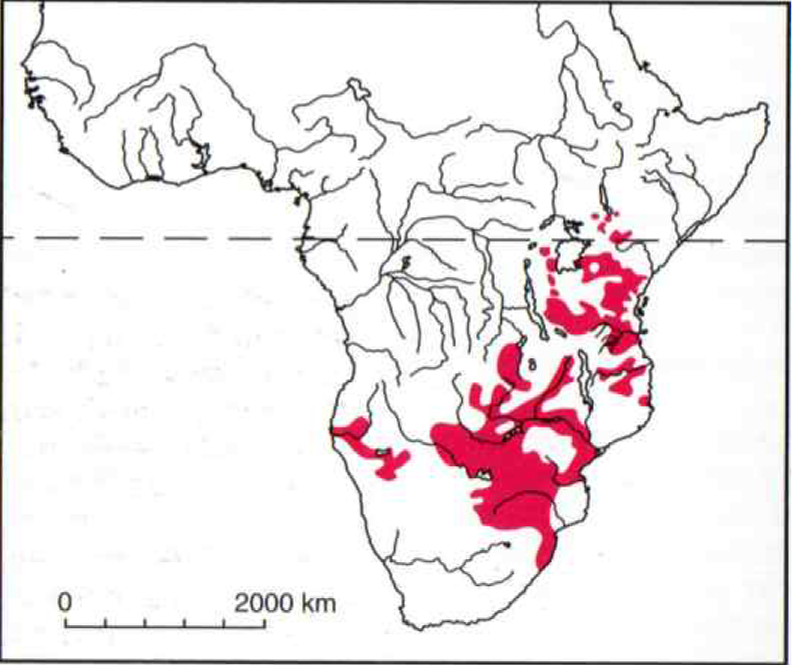
Map 1: Distribution of impala Aepyceros melampus according to Kingdon (2011).
Like the Common Impala the Black-faced Impala is a water dependant mixed feeder; both grazing and browsing depending on the available fodder in respective seasons. Having relatively small pointed hoofs, it prefers firm footing and, as in its anti-predatory tactics, it relies on scattering with high jumps, it avoids deep sand. While the impala certainly is not a migratory species, it must be mentioned that the Black-faced Impala, adapted to arid conditions, is very opportunistic in utilising changing situations and therefore suddenly appears in isolated pockets with favourable conditions.
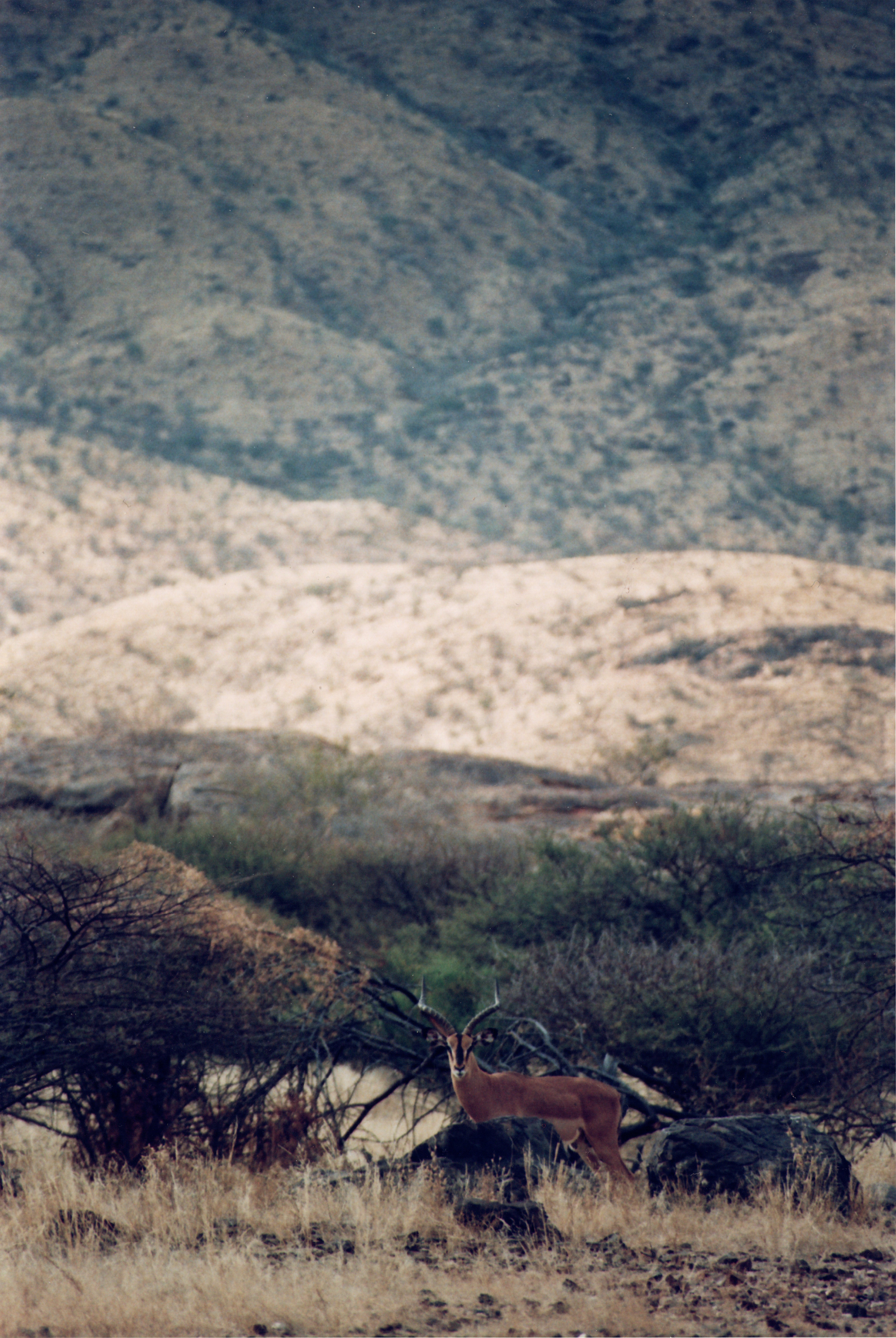
The distribution of the Black-faced Impala generally is given as being Southwestern Angola between the Kunene and the Coporolo Rivers and Kaokoveld in Northwestern Namibia. However, there is uncertainty about their present status in Angola. The Namibian historical distribution range for long was considered to be restricted to the valley of the Kunene River in Kaokoveld. This certainly is not correct.
This first was brought to my knowledge by the writings of Fritz Gaerdes⁴, who pointed out that the Black-faced Impala had a much wider distribution in Namibia. This paper aims at looking into the origin (appearance) of Aepyceros melampus petersi in Northwestern Namibia and the historic distribution range of the sub-species in Namibia. It discusses the situation of Aepyceros melampus in Namibia before the introduction of South African Common Impala by game ranching. I must mention that I’m not a scientist, however, have considerable practical experience regarding Namibia’s wildlife and have been involved in conservation issues for decades. The paper originates in studies done prior to the reintroduction of Black-faced Impala into the Erongo Mountains, where, within the Erongo Mountain Nature Sanctuary, today an estimated minimum of 1000 Black-faced Impalas occur.
Sub-species development and distribution pattern
In general it can be said that a sub-species to a certain species develops, if a population in which a certain characteristic is prevalent is separated or isolated from the main population. Climatic conditions played a major role in the distribution of African antelope and the changing of biomes across Africa. During pluvial (wet) periods the rainforest stretched from the Atlantic Ocean in the west to the Indian Ocean in the east, facilitating the dispersal of forest forms. During inter-pluvial (dry) periods the rainforest retracted and in certain areas was reduced to islands, mainly in the form of isolated montane forest (cloud forests), “trapping” relict animal sub-populations separated from the main population, like for example the Eastern Bongo, Tragelaphus euryceros issaaci, and several duiker species. At the same time a drought corridor extending through eastern Africa connected the savannah and arid biomes; this explains the presence of the same mammals in the Somali Arid Zone and South West Arid Zone, separated by the Miombo Woodland Zone, for instance oryx, dik-dik, steenbok ⁵,⁶.
The gemsbok Oryx gazella gazella, one of three sub-species of Oryx gazella - the other being Oryx gazella callotis (Fringe-eared Oryx) and Oryx gazella beisa (the Beisa Oryx)⁷ - during inter-pluvial periods spread to the South West Arid Zone from the Somali Arid Zone through a drought corridor that was closed again by the Miombo Woodland Zone during pluvial periods. Separated from the main population, the gemsbok developed its distinctive criteria. The same applies to the Damara Dik-dik, Madoqua kirkii damarensis, a subspecies of Kirk’s Dik-dik, Madoqua kirkii kirkii. The Steenbok, Raphiceros camprestris, being a southern African species, spread into the opposite direction and nowadays occurs in separate populations in the Southwest and Somali Arid Zones.
The peculiarities and similarities of these developments and the spreading of gemsbok, dik-dik and steenbok into southwestern Angola are worth mentioning in relation to the distribution of the Black-faced Impala. It seems almost certain that the Black-faced Impala was separated from the nominate population by drought factors. Moreover, it needs to be highlighted that geological features that allow corridors of differing circumstances and vegetation types within an otherwise distinct biome, played a major role in the distribution of African antelopes. The Great Rift Valley, along which the exchange of species between the northern and southern savannahs was possible, may serve as a striking example⁸.
Historic references of impala in Namibia
A major difficulty in determining the historic distribution range of Black-faced Impala in Namibia lies in the fact that almost none of the early observers differentiated between the sub-species. Most of these explorers in general speak about “rooibokke”, the Afrikaans name for impala, or about “pallah”, their name in several native languages.
As the black-faced sub-species was only described in 1878 and, moreover, then named the “Angolan Impala”, early authors like Andersson, who travelled in Namibia from 1850 onwards and died in 1867, of course would not have mentioned the difference. According to Shortridge, Black-faced Impala were first met with in Namibia’s Kaokoveld by Cookson in 1889. This, however, must be placed in perspective as the Humpata Boers, who between 1879 and 1908 made regular ivory-poaching raids into Kaokoveld, narrated that “rooibokke“ (impalas) had been their most frequent meat supply on both sides of Kunene River⁹. This without doubt had been the petersi sub-species. The same applies to Fischer’s account of impala at the southern edge of Etosha pan.
To my knowledge Shortridge was the first to try and give a scientific account of the distribution of the impala sub-species in South West Africa, now Namibia. He gives the distribution range of Aepyceros melampus melampus in Namibia as being “the valley of the Okavango and the Caprivi” and that of Aepyceros melampus petersi as being “the Cunene watershed from about longitude 13E, to the western corner of the Ovambo-Angola Border, and a small area at the southern edge of the Etosha Pan”¹⁰.
However, Shortridge randomly classifies historic records of impala that do not fall into either of the distribution ranges given of the respective sub-species by himself. It is an erroneous belief that Black-faced Impala in Namibia are restricted to the Cunene, “…but do not extent more than a few miles from the river…”.
Here now follow some distribution references for the respective sub-species and an attempt to assign them more correctly.
a) Common Impala/impala without differentiation of sub-species
When in 1850 Francis Galton and Charles John Andersson ventured from Walfish Bay into the interior of the territory then called Damaraland with the actual intention to reach Lake Ngami, travelling mainly along the riverbed of the Swakop, they encountered the first “Pallah” in the vicinity of Schmelens Hoffnung (Okahandja). On account of rumours about a “Lake Omanbonde” where hippopotamus were said to live, they postponed their Lake Ngami plans and trekked northward to find Lake Omanbonde, which turned out to be a major disappointment. Lake Omanbonde turned out to be not more that a reed covered vley in the Omuramba Omanbonde, a tributary of the Omuramba Omatako. However, although game was sparse at the time, Andersson reports having bagged a few “pallahs” there¹¹. These - far away from any spot where Common Impala were reported with certainty, but in a vicinity where Black-faced Impalas definitely occurred - in my opinion with certainty must have been melampus petersi. I will elaborate on this later.
Andersson also mentions that later, on their way to come closer to Lake Ngami, game was very plentiful in the east of the country and that he managed “…within a few hours to bag no less than three hartebeests, two pallahs, and five zebras…” somewhere between Eikhams (Windhoek) and Elephant Fontein (Gobabis).
In the journals of Missionary Carl Hugo Hahn there is the following entry for 21 May 1857, Schmelens Hoffnung, “…Petrus shot a Red Buck [Rooibok], a very beautiful antelope species that is very plentiful here” (Translated from German by KUD; Rother Bock = Red Buck = Rooibok)¹². This confirms Andersson’s reference to the occurrence of impala at Schmelens Hoffnung in 1850. In my opinion this most likely must have been Black-faced Impala.
In 1859, at the Nossob River in eastern Namibia, James Chapman, returning through Damaraland to Walfish Bay from an expedition to Lake Ngami and the Okavango River, saw “…some fine pallahs, larger than those at the lake…I could not succeed in bagging a very fine brace of pallah bucks, which I wanted for the Cape Town Museum”¹³. It is truly regrettable that Chapman did not succeed in bagging these impalas for the Cape Town Museum. That could have shed some light on the matter. Noteworthy, however, is that Chapman, on the grounds that he considered the Nossob impalas bigger than those at Lake Ngami, considered the effort worth a try. Gaerdes indicates that the impala at the Kunene are bigger than those at the Okavango. I myself have the impression that the Black-faced Impalas in the Erongo Mountains are distinctly bigger than those of Mahango Game Park at the Okavango River and those in South Africa's Kruger Park.
Listed under his account of Common Impala Shortridge states that “…Up to the early days of European settlement, small, perhaps migrant, herds of impala are said to have existed around Omatako Mountain (Okozongutu) and along the Omaruru River”. These - far away from any spot where Common Impala were reported with certainty, but in a vicinity where Black-faced Impalas definitely occurred - in my opinion must have been Black-faced Impalas. I consider this reference of impala at the Omatako Mountain and along the Omaruru River as a key reference. I will elaborate on this later.
Under this same account Shortridge speaks of “…(herds of impala) along that part of the Nossob where Gobabis Town now stands…”.
William Chapman¹⁴, son of the famous explorer James Chapman, hunted and traded in Damaraland and Kaokoland from 1874 onwards and, since 1881, in Southern Angola, where he became a respected member of the Angola Boer Community. In his reminiscences there are several references to rooi-bokke in northwestern Namibia and southwestern Angola. In 1875 he first reached Pallah Fountain just south of where Outjo nowadays stands. He states: “…Pallah Fountain was merely a few pits with abundance of water, which in good rainy seasons is on the surface, hence it having acquired the name of ‘fountain‘ and ‘pallahs or rooi-bucks’ were found here by the first hunters and in my time were still there”. This is a most valuable information as, without doubt these were Black-faced Impalas.
As already stated above, in Jagkonings, J. Von Moltke narrates that impala (“rooibokke“) were frequently encountered by the Humpata Boers between 1879 and 1908 during ivory poaching raids into Kaokoveld. These of course were Black-faced Impalas.
Lieutenant Adolf Fischer, from 1906-1909 “Districtschef von Namutoni“ (district chief of Namutoni), to my knowledge was the first to mention impala on the southern edge of Etosha Pan¹⁵. These, without doubt, were Black-faced Impala.
During a hunting trip into the Khaukauveld in 1917, Mattenklodt and Wilhelm encountered impala to the west of Gautsha Pan, south of where Tsumkwe nowadays is¹⁶. There is further reference to impalas in this vicinity (near Tsumkwe and in the Chaudum Omuramba) in the 1970s in a paper by Joubert and Mostert¹⁷. These Kaukauveld impalas surely must have been Aepyceros melampus melampus.
The above mentioned paper by Joubert and Mostert is immensely insightful and directional, as it describes the natural occurrence of impala in Namibia, an arid country: both sub-species being on the decline Aepyceros melampus melampus occurring only in infinitely small numbers in the northeast, Aepyceros melampus petersi, the arid climate adapted impala, though in healthier numbers dwindling away in the northwest, mainly due to competition with humans and their livestock around waterholes.
b) Black-faced Impala
Shortridge probably was the first to make deliberate scientifically-orientated references of Black-faced Impala in Namibia at a time when any impala, irrespective of where they were found, were merely classified as “pallah”. He mentions that Aepyceros melampus petersi are plentiful in Kaokoveld along the lower Cunene. Moreover he states for “The Etosha Pan: A small isolated herd of Angolan Impala, estimated at about 200 head, was recently discovered in the vicinity of some springs along the southern edge of the Pan, where, in 1926, a specimen was shot by H.E. the Earl of Athlone. This herd probably originated from a small party which - during some period of heavy rain - trekked south from the Cunene and remained in the Namutoni Game reserve owing to the existence of a permanent, though limited water supply”. It must be reiterated that the occurrence of impala at the southern edge of Etosha Pan was known since 1906 (Fischer) and, as will be seen hereunder, to old Hai//om, who were born and lived in Etosha. It must be pointed out that Shortridge’s statement that the Etosha population probably trekked down from the Kunene is mere speculation.
Shortridge mentions that Steinhardt recorded an instance of a pair of Black-faced Impalas that were shot at Franzfontein in 1913. I could not find this specific reference in Steinhardt’s book Ehombo¹⁸ although there is mentioning of pallah in Kaokoveld, but it might have been in another publication.
Fritz Gaerdes¹⁹ (speaking in third person, obviously relating to himself as “Naturliebhaber” = nature lover) narrated how a farmer in the Outjo District invited himself, the nature lover, to show him something special at a farm dam, which turned out to be three young Black-faced Impala rams. Gaerdes clearly discerned the characteristic black face markings of the animals through his binoculars. The farmer then told him that on a neighbouring farm a larger group of 15-20 of the animals had appeared. Unfortunately no mentioning is made of the name of the farms and the year, probably in the 1960s, as the foreword to the book is dated 1965. Gaerdes then continues to state that in earlier times Black-faced Impalas occurred to the south of Outjo and even further south. And that in Etosha a small population exists. He speculates that the animals in question may be an attempt of the species to repopulate their old range. He concludes the account that four years later, when he visited the farmer once more, the impalas had disappeared again. In an earlier publication Gaerdes²⁰ states that impala had occurred at the Etjo Mountain. It can be assumed that his above mentioned remark “south of Outjo and even further south” points in this direction. Fritz Gaerdes, unlike many of his contemporaries, was an analytical thinker and his brief comments regarding Aepyceros melampus petersi are of great value.
There are some indications that Gaerdes spoke of the farm Katemba, owned by Konrad Zander at that time. Zander²¹ mentions that at a dam on his farm eight Black-faced Impalas gradually had established themselves but sadly later were shot on farms in the vicinity.
In the 1960s Eugene Joubert²² spent four years in the Kaokoveld and kept notes wherever he encountered Black-faced Impalas and “established their present distribution fairly accurately”. He proved that “They are not restricted to the banks of the Kunene River but also occur in several other localities, some of which are very isolated...At present their most southern distribution is at Kamanjab”.
Reinhard Friedrich reports that, when questioning some of the older Hai//om, who still were born and lived in Etosha, they told him that Black-faced Impalas occurred along the southern edge of the pan, at times in large numbers at certain waterholes (1907/8)²³.
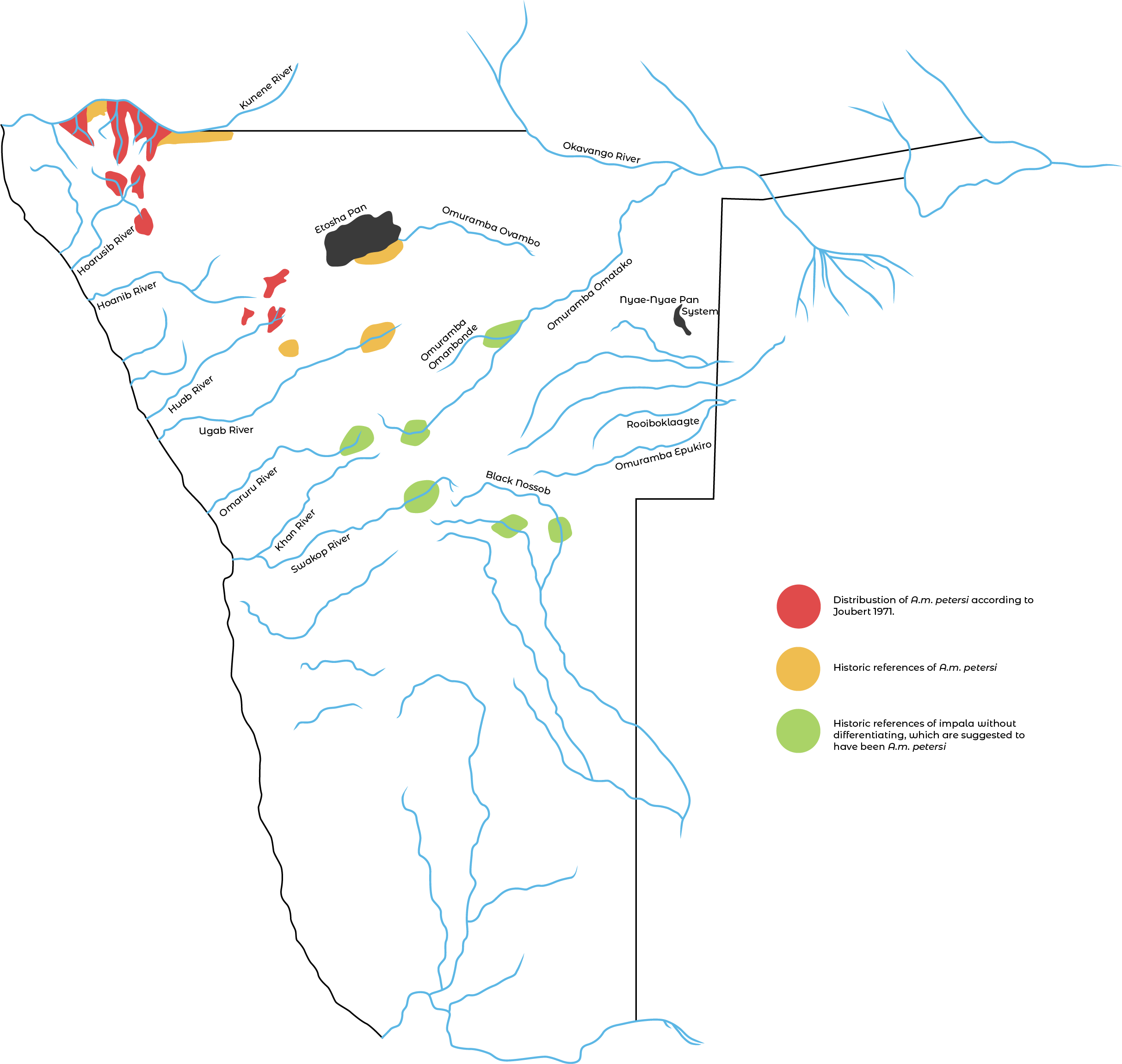
Map 2: Distribution of Aepyceros melampus petersi in Namibia
The historic distribution range of Aepyceros melampus petersi in Namibia and factors that may have influenced their distribution
The distribution range of the Black-faced Impala in modern times generally was considered to be the valley of the lower Kunene River on both sides of the river in particular, but in principle also extending northward to the Coporolo River in Angola and southward to the Ugab River in Namibia.
The most important question must be: How did the Black-faced Impala Aepyceros melampus petersi arrive at the Kunene River?
I could not find any reference to impala of either sub-species having ever occurred in the central highlands of Angola. The distribution of Aepyceros melampus melampus generally is given as the Cuando Cubango area in eastern Angola, north of the Okavango River. The range of Aepyceros melampus petersi in Angolais bound by the barrier of the spectacular escarpment of the Serra da Chela and other escarpments towards the north and east of the Coporolo River.
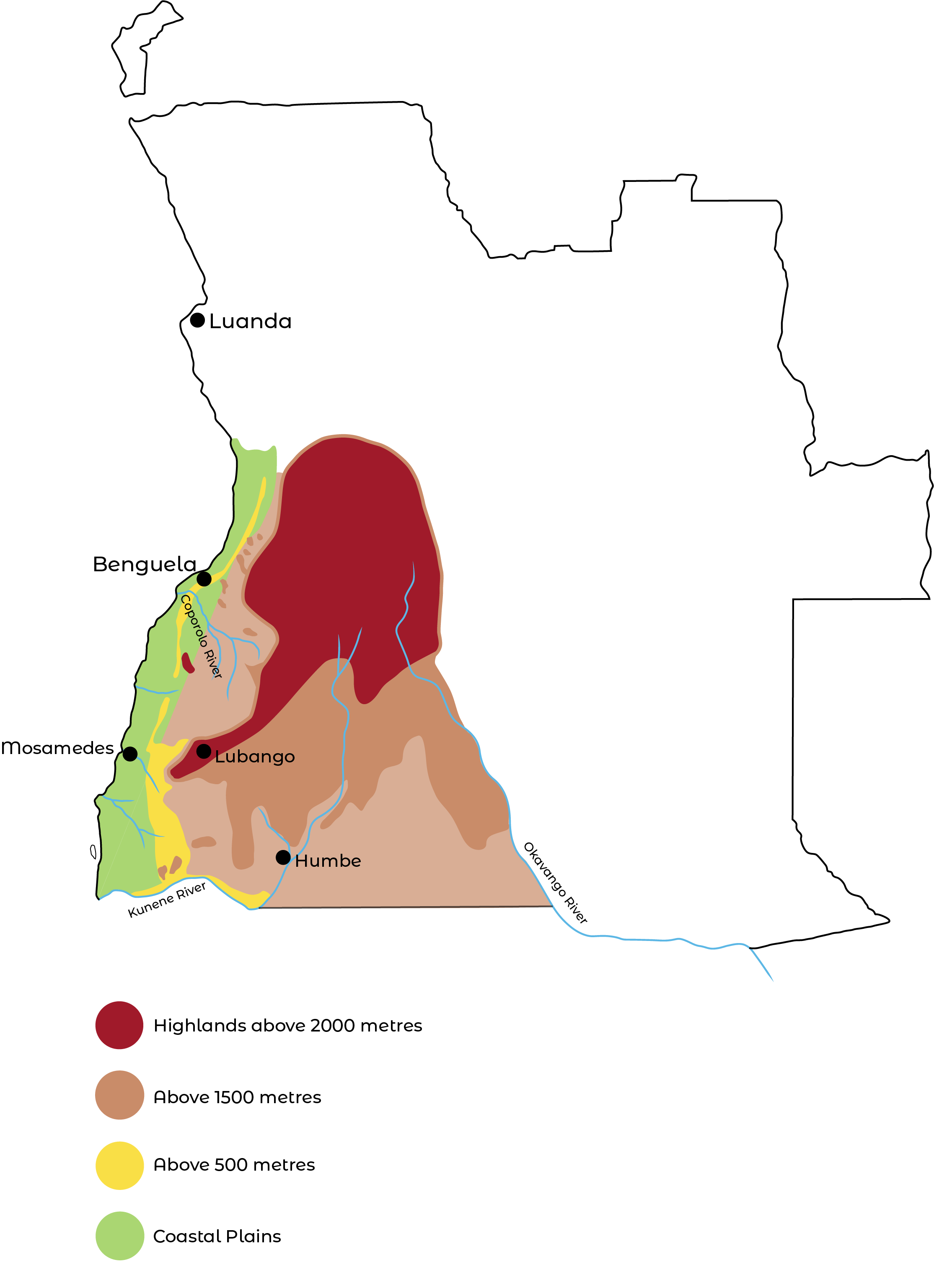
Map 3: Geological features within the distribution range of Aepyceros melampus petersi between the Kunene River and the Coporolo River in southwestern Angola
Similarly, there is no record of impala of either sub-species having ever occurred in central northern Namibia (Ovamboland) except for Aepyceros melampus petersi at the extreme northwestern corner near Ruacana. It thus must be considered almost certain that Aepyceros melampus, before or since the separation of sub-species, distributed towards and beyond the Kunene River from the south. The distribution of typical Namibian species like Hartmann's Zebra, gemsbok, springbok, dik-dik and steenbok across Kaokoveld into southwestern Angola cannot but evoke notice of similarity with that of the Black-faced Impala. Considering Kingdon's statement that the Black-faced Impala is “...a relict population with several conservative features...”, separation of the sub-species, which were connected during pluvial periods, must have occurred very early.
The question is: for which reasons and along which line happened the separation of the impala populations at the Okavango River and those in the north-central highlands of Namibia, which lead to the isolation of the relict population of the Black-faced Impala?
It is suggested that the Rinderpest epizootic of 1896-97, that is said to have wiped out up to 95% of Namibia’s cloven-hooved game, created the separation of the two impala sub-species in Namibia²⁴. This would suggest that the two sub-species were connected almost until the turn of the nineteenth century, which appears an unrealistic short remaining timespan of isolation for a relict population with several conservative characteristics, that is considered a separate species by some (Joubert following Oubussier²⁵). Moreover, it is unlikely that an epizootic alone would entirely wipe out a species within large, well suited habitat.
The separation between the Aepyceros melampus sub-species almost certainly must have been due to drought factors. It appears logic that the drought corridor that connected the Somali Arid Zone with the South West Arid Zone during inter-pluvial periods and allowed the dispersal of species like gemsbok and dik-dik into the southwest of the continent, on the other hand separated the impala populations in Namibia.
It must be emphasised that a large, unbroken tract of country in Namibia between the Okavango River, where A. melampus melampus occur, and north-central Namibia's Highland, more or less in a line from Ondangwa in the northwest via Otjituo down to the far southeast of the country, consists of deep sand (Arenosols) without surface water, largely unsuited as natural impala habitat. It seems difficult to imagine any other dividing line that, through drought factors, could have separated the Aepyceros melampus melampus population along the Okakavango from the Aepyceros melampus petersi population than the huge stretch of waterless deep sand in north-eastern Namibia.
The connectivity of the two populations and the dispersal of animals during pluvial periods must have occurred along some drainage line, which could provide a corridor of differing circumstances (Fluvisols) within the distinct surrounding waterless sand-veld. This drainage line corridor almost certainly must have been the Omuramba Omatako.
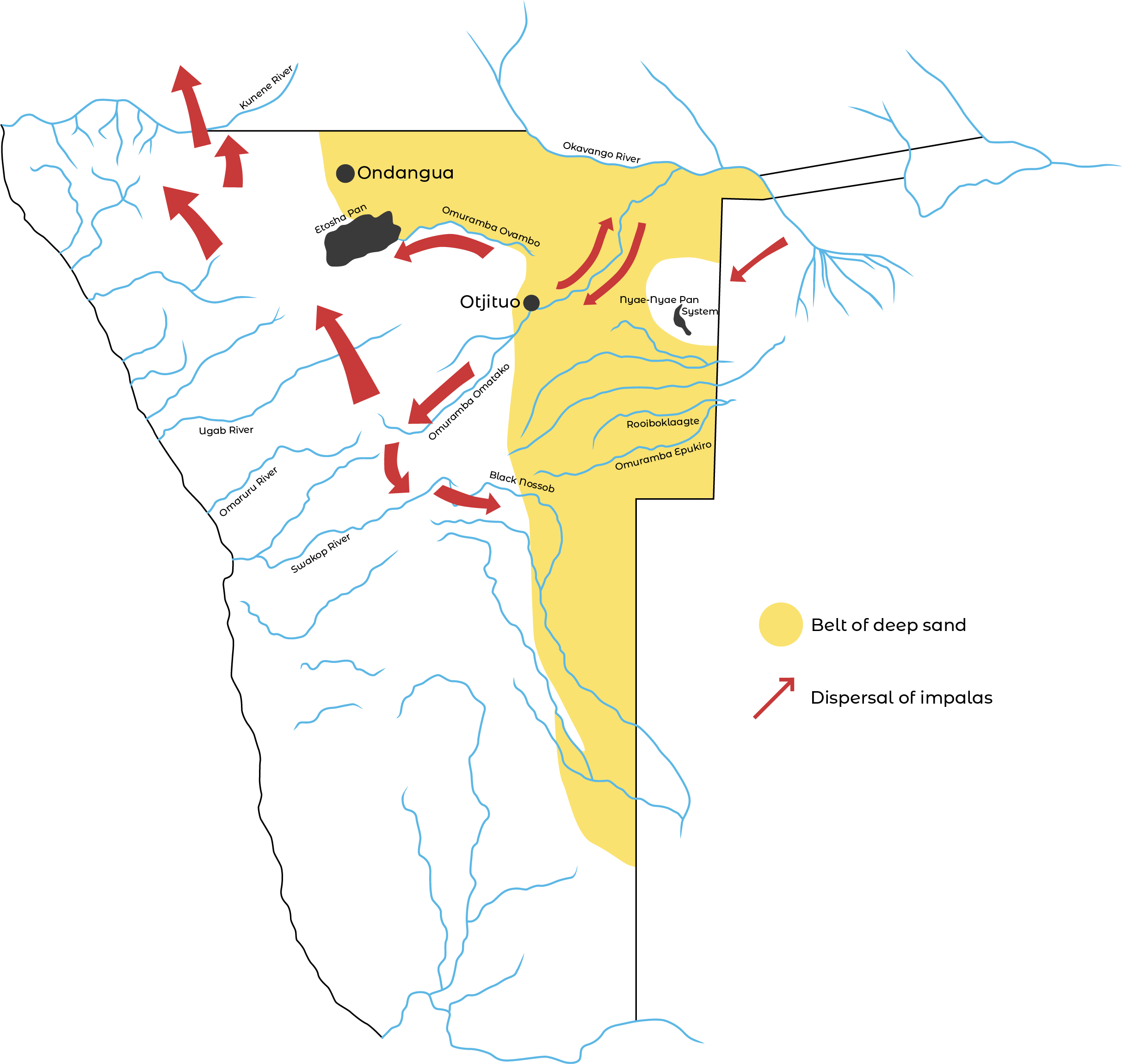
Map 4: The suggested early connectivity of impala populations at the Okavango River and the north-central highlands of Namibia along the Omuramba Omatako and their dispersal to the west, northwest and southeast
The Etosha population warrants brief special discussion. There is a tendency to comment any discovery of pertersi populations, even far from the Kunene valley as “...must have trekked down from the Kunene”. It is well possible, and more likely in my opinion, that the Etosha population, known to insiders for long (Fischer, old Hei//om inhabitants of Etosha), originates from the early dispersal of impalas along the Omuramba Omatako and from there along the Omuramba Ovavambo to Namutoni.
In some way one might be inclined to attribute historic occurrence of impala at the Nossob River to the Common Impala as they are relatively close to the Botswana border and there are drainage line corridors (though distant) towards the Okavango Delta in the east-flowing Omurambas. However, theses Omurambas are entirely within the deep sand belt and anyhow trickle away in the Kalahari sands. The Namibian Biodiversity Database²⁶ attributes historic records for impala in eastern Namibia by Galton, Andersson and Chapman to the black-faced sub-species, which seems plausible as the dispersal of Black-faced Impala from the Swakop River into the Nossob River (the sources of both rivers almost touching each other) along absolutely suitable habitat appears quite natural.
All the impala that were encountered by Andersson, Hahn and others in the mid-nineteenth century, and references made to by Shortridge and others, of animals to the west of the dividing line must have been of the Black-faced Impala Aepyceros melampus petersi.
The contracting of the historic range of Black-faced Impala towards the northwest of Namibia must be attributed to two aspects: Availability of surface water, in particular during drought periods, and competition with livestock. Andersson already writes about the devastating effect the cattle herds of the Herero had in particular around waterholes, leaving little room for other animals. In the same way Joubert recounts the dwindling away of their numbers, “...mainly owing to continuous drought, hunting pressure and competition from livestock” in the Kaokoveld. The competition with humans and livestock in an arid country, more than anything else, explains their concentration along the valley of the lower Kunene: Here was access to a long stretch of permanent surface water.
Lastly, it seems helpful to interlude some observations of Black-faced Impala behaviour from the Erongo Mountains. Black-faced Impala tend to be very sedentary if they experience favourable conditions but they are mobile and opportunistic under drought or predator stress conditions, moving from the valleys into rocky slopes for lambing and gathering near human habitations in large numbers for the night when the lambs are young to avoid predators, and are unexpectedly found in remote mountain valleys where vegetation might be better during severe droughts.
This may give some explanation to Joubert's finding that they “...occur in several other localities, some of which are very isolated” in the Kaokoveld, which, though on a much larger scale, has quite some similarity with the Erongo Mountains.
The impala that occurred in the Kaukauveld in historical times (Mattenklodt, Wilhelm, Joubert) certainly must have been Aepyceros melampus melampus as the larger Nyae Nyae Pan System is a calcarious island in the deep sands of north eastern Namibia, close to and well linked to the Okavango by drainage line corridors (Khaudum and Nhoma Omurambas), which always have been used by migrating wetland species like reedbuck, hippo, buffalo and others, even in present times.
On old maps a northern tributary of the Omuramba Epukiro is named “Rooiboklaagte”, which indicates the occurrence of impala here in previous times. The Omuramba Epukiro trickles away in the deep Kalahari sand not far beyond the Botswana border on the height of Lake Ngami. The question is whether the drainage line of the Rooiboklaagte Omuramba, as far as the occurrence of impala is concerned, has to be considered part of the larger Nyae Nyae area.
It is the thesis of this paper that all historic reference to impala in the Central Highlands of Namibia are of the black-faced sub-species Aepyceros melampus petersi.
Conclusion
The Black-faced Impala Aepyceros melampus petersi must be considered a rare but truly characteristic Namibian impala sub-species, adapted to arid conditions. Its early naming as the "Angolan Impala" seems unsuited as together with other characteristic Namibian species like Hartmann's Zebra, gemsbok, springbok and dik-dik it dispersed into southwestern Angola across the Kunene River from Namibia.
Its historical Namibian distribution range should be considered as most of central northern and north western Namibia, in most parts overlapping with the distribution range of the Damara Dik-dik Madoqua kirkii damarensis with which it shares the same habitat, both species in particular avoiding deep sand.
It is very unfortunate that through thoughtless game ranching practices this iconic Namibian animal was brought into a fundamental crisis, which seems to be very, very difficult to rectify.
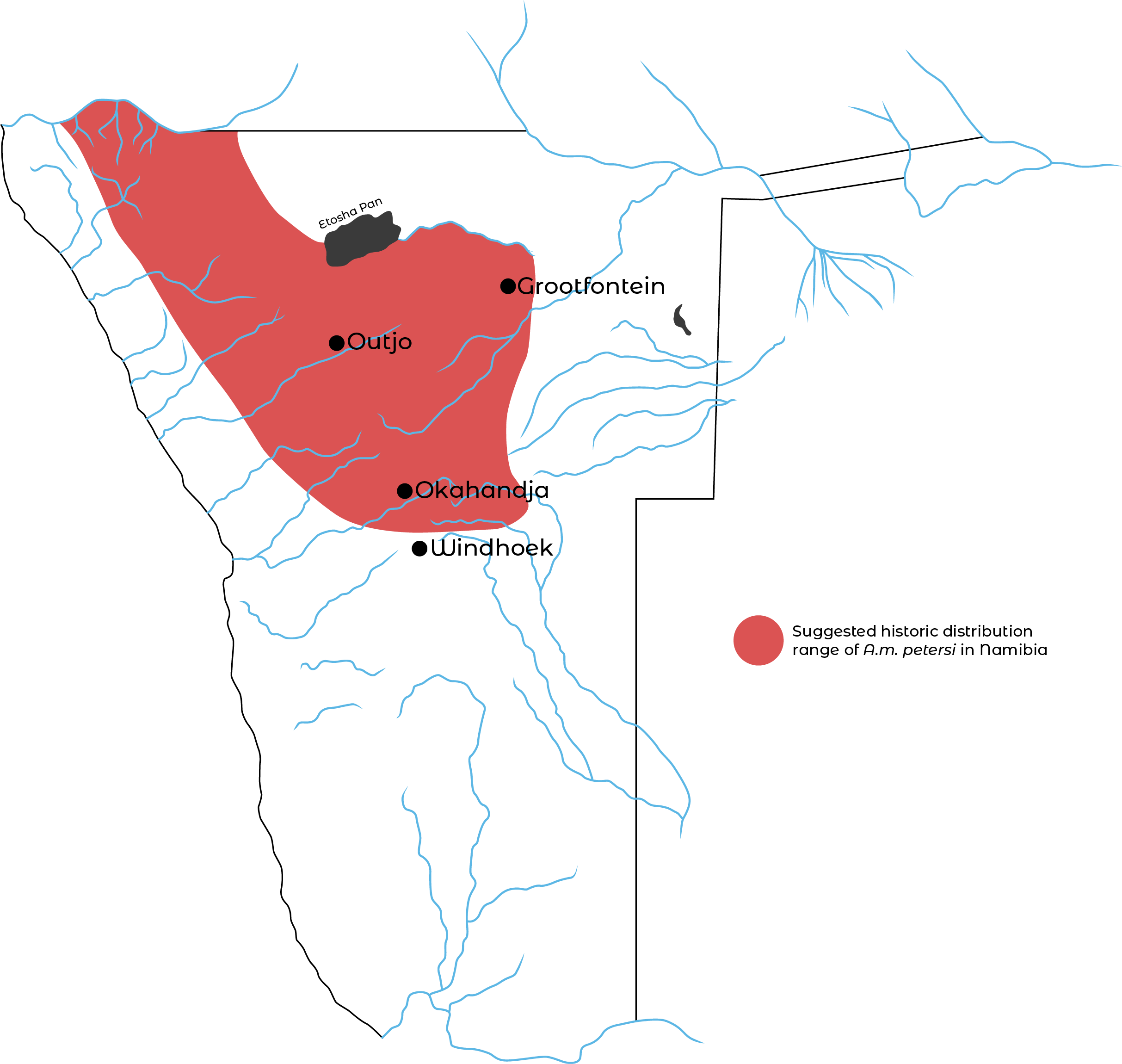
Map 5: The suggested historic distribution of Black-faced Impala Aepyceros melampus petersi in Namibia
Acknowledgements
I want to thank Dr Malan Lindeque for supplying additional references and my colleagues at the Ameib Scientific Station, Hagen, Katrin and Ilka Denker, for support in discussing the issue and various technical help.
References
¹Shortridge, Captain G.C., The Mammals of South West Africa, London, William Heinemann LTD, 1934
²Kingdon, Jonathan, The Kingdon Field Guide to African Mammals, A&C Black Publishers Ltd., London, fifth edition, 2011
³Estes, R. D., The Behavior Guide to African Mammals, Russel Friedman Books South Africa
⁴Fritz Geardes, Tierleben in Südwest Afrika, & Tiere im Veld, Verlag der Wissenschaftlichen Gesellschaft, Windhoek
⁵Estes, R. D., The Behavior Guide to African Mammals, Russel Friedman Books South Africa
⁶Fauna, das große Buch über das Leben der Tiere, Band 1, Afrika (Äthiopische Region), Novaria Verlag München, 1971
⁷Following the classification of Estes
⁸Fauna, das große Buch über das Leben der Tiere, Band 3, Afrika (Äthiopische Region), Novaria Verlag München, 1971
⁹J. von Moltke, Jagkonings, first edition 1943, second edition, Protea Boekhuis Pretoria, 2003
¹⁰Shortridge, Captein G.C., The Mammals of South West Africa, London, William Heinemann LTD, 1934
¹¹Andersson, Charles John, Lake Ngami, African Collection, Briar Patch Press, Camden, South Carolina, 1988
¹²Walter Moritz, Erkundungsreise ins Ovamboland 1857, Tagebuch Carl Hugo Hahn, Printed: John Meinert, Windhoek 1980
¹³Chapman, James, Travels in the interior of South Africa, 1849 - 1863, A.A. Blakema, Cape Town, 1868
¹⁴William Chapman, Reminiscences, edited and annotated by Nicol Strassen, Protea Book House, Pretoria, 2010
¹⁵Adolf Fischer, Menschen und Tiere in Südwestafrika, sixth edition, 1936, Safari Verlag, Berlin
¹⁶Mattenklodt, E. W., Verlorene Heimat, 1936, Berlin
¹⁷Joubert, E. & Mostert, P.K.N. 1975. Distribution patterns and status of some mammals in South West Africa. Madoqua 9: 5-44
¹⁸Steinhard, Julius, Ehombo, Verlag Neumann inNeudamm, fifth edition, 1924
¹⁹Gaerdes, Fritz, Tiere im Veld, Verlag der SWA Wissenschaftlichen Gesellschaft, second edition 1977
²⁰F.Gaerdes, Tierleben in Südwest Afrika, Verlag der Wissenschaftlichen Gesellschaft, Windhoek Foreword dated 1961
²¹Zander, Konrad, Ein Südwester Farmer, Jäger und Maler, Kuiseb Verlag, Windhoek, 1999
²²Joubert, Eugene, Observations on the Habitat Preferences and Population Dynamics of the Black-Faced Impala Aepyceros petersi Bocage, 1875, in South West Africa, Madoqua , Ser. I No.3 1971
²³Reinhard Friedrich/Horst Lempp (Editor), Etosha: Hai//om Heartland, Namibia Publishing House, 2014
²⁴Namibia Biodiversity Database
²⁵Joubert, Eugene, Observations on the Habitat Preferences and Population Dynamics of the Black-Faced Impala Aepyceros petersi Bocage, 1875, in South West Africa, Madoqua , Ser. I No.3 1971
²⁶Namibian Biodiversity Database, Internet
References used for compiling of the maps:
1. Atlas of Namibia, First Published by Namibia Nature Foundation, Windhoek 2022
2. Großer Deutscher Kolonialatlas, Berlin 1901 - 1915, Reprint 2002 Archiv Verlag GmbH, Braunschweig
3. Endemism in the Highlands and Escarpments of Angola and Namibia, Namibia Journal of Environment, 2023: Volume 8
4. Meyers Neuer Weltatlas, 2011, Deutschland
5. South-West Africa/ Namibia 1979, 1 : 1 000 000, Office of the Director-General of Surveys, published by the Surveyor-General, Windhoek